What Is AI Automation for Small Business? Benefits, Examples & Getting Started (2026)
Learn what AI automation for small businesses is, how it works, real-world use cases, key benefits, common myths, and the best AI tools to save time and grow your business.
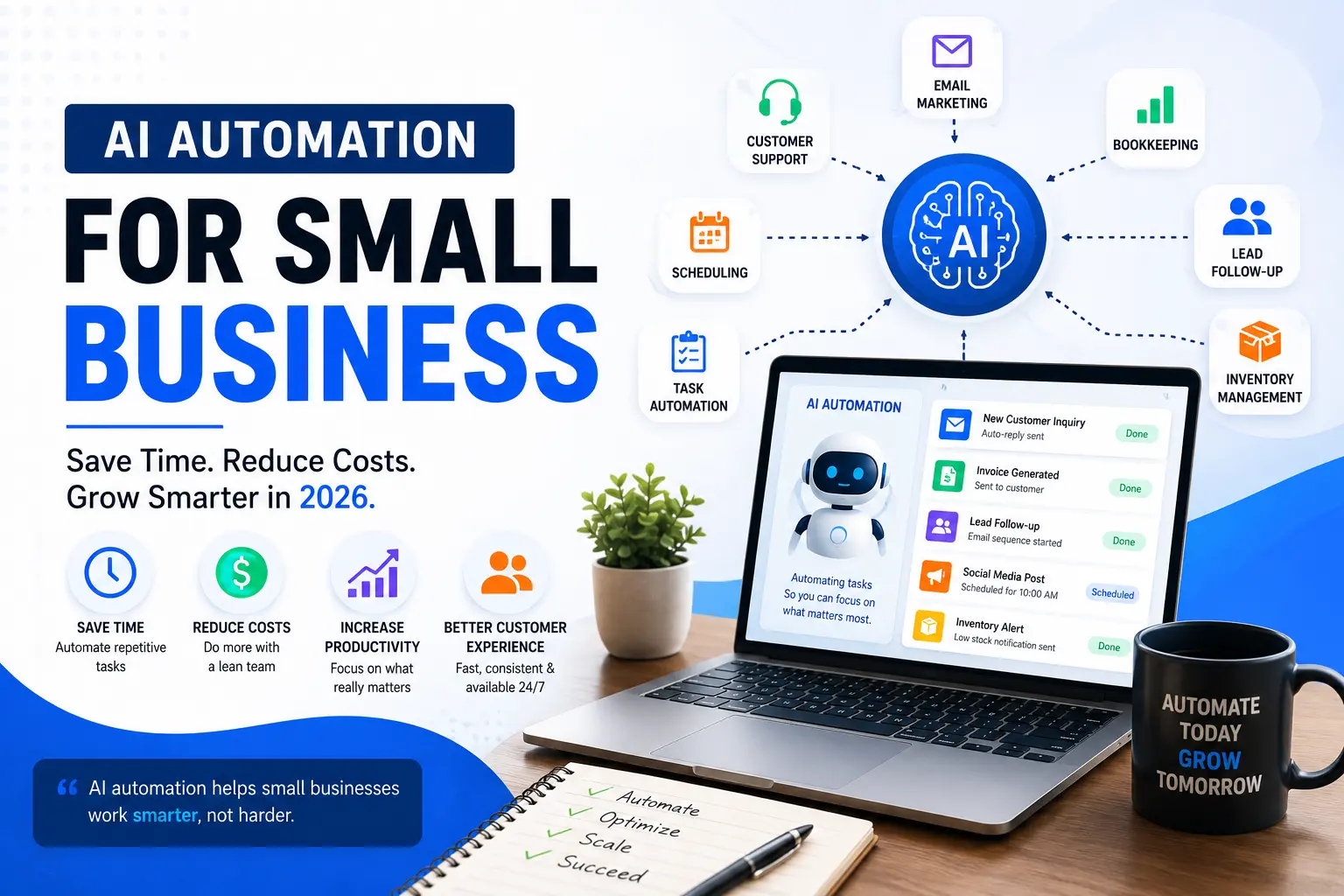
What is AI automation for small business?
Most small business owners aren’t short on ideas. They’re short on time.
Between answering emails, chasing invoices, posting on social media, and doing the actual work they started the business to do, the admin load never stops building. AI automation is what eats that load.
Short version: AI automation for small business means using software to handle repetitive tasks without you touching them. A customer emails at 2am. The software reads it, routes it, and sends a reply. You wake up to a solved problem.
What exactly is AI automation?
Software that handles tasks on your behalf, often without needing a specific rule written for every possible situation. And there are 2 versions worth understanding.
Plain automation is rule-based. If this happens, do that. Zapier moving a row to your CRM when someone fills out a form. Useful. Reliable. Completely without judgment.
AI automation handles variation. It reads a customer complaint and figures out whether it’s a billing issue or a delivery problem, without you pre-writing a rule for every scenario. Tools powered by models like Claude, ChatGPT, or Google’s Gemini are running inside small business workflows right now doing exactly this.
The line between the two is blurring fast. Most modern tools are both.
Why does this matter specifically for small businesses?
Because small businesses carry disproportionate workloads with lean teams. The U.S. Small Business Administration counted 33.2 million small businesses in America as of 2023, employing about 61.7 million people.
A 2023 Guidant Financial survey found 73% of small business owners work more than 40 hours a week. That’s before accounting for the things that fall through the cracks between people.
Hiring to fill every gap isn’t realistic. You probably can’t put a full-time bookkeeper, a dedicated customer service rep, and a marketing coordinator all on payroll at the same time. AI automation covers pieces of all three at a fraction of the cost. Time recovered. Capacity added without adding headcount.
What can small businesses actually automate?
More than most owners expect. Here’s where it shows up in practice.
Customer service. AI chatbots handle the questions your customers ask on repeat. Hours, return policies, order status, appointment availability. Tools like Tidio or Intercom cover these in real time, around the clock, without anyone staffing a queue. Setup takes a weekend, not a month.
Email marketing. Mailchimp and Klaviyo use AI to figure out optimal send times per subscriber, test subject line variations, and segment lists based on actual behavior. You write the email once. The platform handles the rest.
Bookkeeping. QuickBooks and Wave categorize transactions, flag unusual charges, and generate reports automatically. One restaurant owner profiled in Inc. magazine cut her weekly bookkeeping time from 6 hours to under 1 hour after switching to automated categorization.
Scheduling. Calendly and Acuity Scheduling handle appointment booking without the email back-and-forth that somehow stretches across 4 days. A client picks a slot. It lands on your calendar. Nobody touches it.
Lead follow-up. This is where small businesses quietly lose the most money. A lead fills out your contact form. Nobody responds for 6 hours because everyone’s busy with something else. Tools like HubSpot or ActiveCampaign send an automatic reply the moment a form is submitted, then sequence follow-ups based on whether the lead opens the email or clicks a link.
Research from Lead Connect found that responding to a lead within 5 minutes makes you 100x more likely to make contact than waiting 30 minutes. Automation makes that response happen every time, without anyone watching the inbox.
Inventory management. Retail businesses using platforms like Lightspeed or Shopify’s built-in AI features can set automatic reorder triggers and get low-stock alerts before running out of a product. A boutique that used to count stock manually twice a week can let the system flag what needs ordering.
Social media. Buffer and Later suggest posting times based on when your specific audience is actually active. Some tools will draft a caption from a product photo or a brief description. You still approve the content. But the operational layer runs itself.
What are the real benefits?
Time. McKinsey’s Global Institute estimated in a widely cited analysis that roughly 45% of work activities people are paid to do could theoretically be automated with technology that already exists. For most small business owners, that’s exactly where the week disappears.
Consistency. Humans forget to follow up. Software doesn’t. Every new customer gets the welcome sequence. Every invoice goes out on time. That reliability compounds quietly, building customer trust you couldn’t manufacture manually while managing everything else.
Lower cost per task. The Bureau of Labor Statistics put the median annual salary for a customer service representative at about $38,000 in 2023. An AI chatbot handling 80% of your support tickets costs a few hundred dollars a month. You still need a human for complex situations. But the numbers speak for themselves.
Speed. A potential client fills out your contact form and hears back in under a minute. Your competitor responds tomorrow. You get the meeting.
Coverage. AI handles inquiries at 11pm Sunday the same as 10am Tuesday. For small businesses competing against companies with full support teams and dedicated staff, that kind of availability is a genuine edge.
Where does AI automation fall short?
Worth saying clearly: AI automation handles volume and repetition well. It doesn’t handle nuance well.
A billing dispute with an angry long-term customer. An unusual request that doesn’t fit any category. A judgment call that reflects your business’s specific values. Those still need a human.
The practical setup most small businesses land on: let automation handle the first response and routine follow-ups, and route anything unusual to a person. That split covers most of the workload while keeping the situations that actually matter in human hands.
Also worth knowing: a poorly built automation frustrates customers fast. A chatbot that can’t answer anything beyond “let me connect you with our team” is worse than no chatbot at all. Spend the time building these properly.
Common myths about AI automation for small businesses
Myth 1: You need technical skills.
You don’t. Zapier, Make, and most modern AI platforms are built specifically for people who don’t write code. If you can write an Excel formula, you have more than enough background to build a useful automation.
Myth 2: It’s expensive to get started.
Most major platforms have free tiers. Zapier’s free plan covers 100 automated tasks a month. HubSpot’s free CRM includes basic email and task automation. Meaningful results are possible before you spend a dollar.
Myth 3: AI will replace your employees.
AI takes over specific tasks. Your bookkeeper stops manually categorizing 200 transactions and starts analyzing what those numbers actually mean for the business. That’s a better use of their time and yours.
Myth 4: Setup is a major project.
Some automations take 20 minutes. Connecting a contact form to your CRM. Scheduling a week of social content in one sitting. The more complex workflows take longer to build. But “set it up once, runs for a year” is the real experience for most small business use cases.
Myth 5: My business is too small to bother.
No business is too small to benefit from 5 hours back per week. A freelance designer who automates invoicing. A food truck owner scheduling Instagram posts automatically. A therapist using Calendly instead of texting back and forth to book every appointment. Scale isn’t the qualifier.
How do you actually get started?
Pick one problem. The inbox that costs you 2 hours a day. The invoices that go out late every month. The appointment scheduling still happening over text.
Automate that one thing first. Get comfortable with how it works. Then pick the next problem.
Tools worth starting with:
- Zapier or Make for connecting your existing apps without code
- Tidio or Intercom for AI-powered customer chat
- QuickBooks or Wave for bookkeeping and financial automation
- Mailchimp or Klaviyo for email marketing
- Calendly or Acuity for scheduling
- Buffer or Later for social media
None of these require a technical team. Most get you from zero to running in under an hour.
The bottom line on AI automation for small business
The small businesses getting the most from AI automation right now aren’t the ones with the biggest budgets or the most technical staff. They’re owners who identified what was eating their week and stopped doing those things manually.
You don’t need to automate everything at once. Pick the single task that costs you the most time every week.
Start there.
Sources: U.S. Small Business Administration (2023), Guidant Financial Small Business Trends Survey (2023), McKinsey Global Institute automation analysis, Bureau of Labor Statistics Occupational Employment Statistics (2023), Lead Connect lead response research.