AI Jailbreaks Explained: How They Work and How to Defend Against Them
Learn what AI jailbreaks are, how they differ from prompt injection, why system prompts aren't enough, and 5 practical defenses for securing LLM applications.
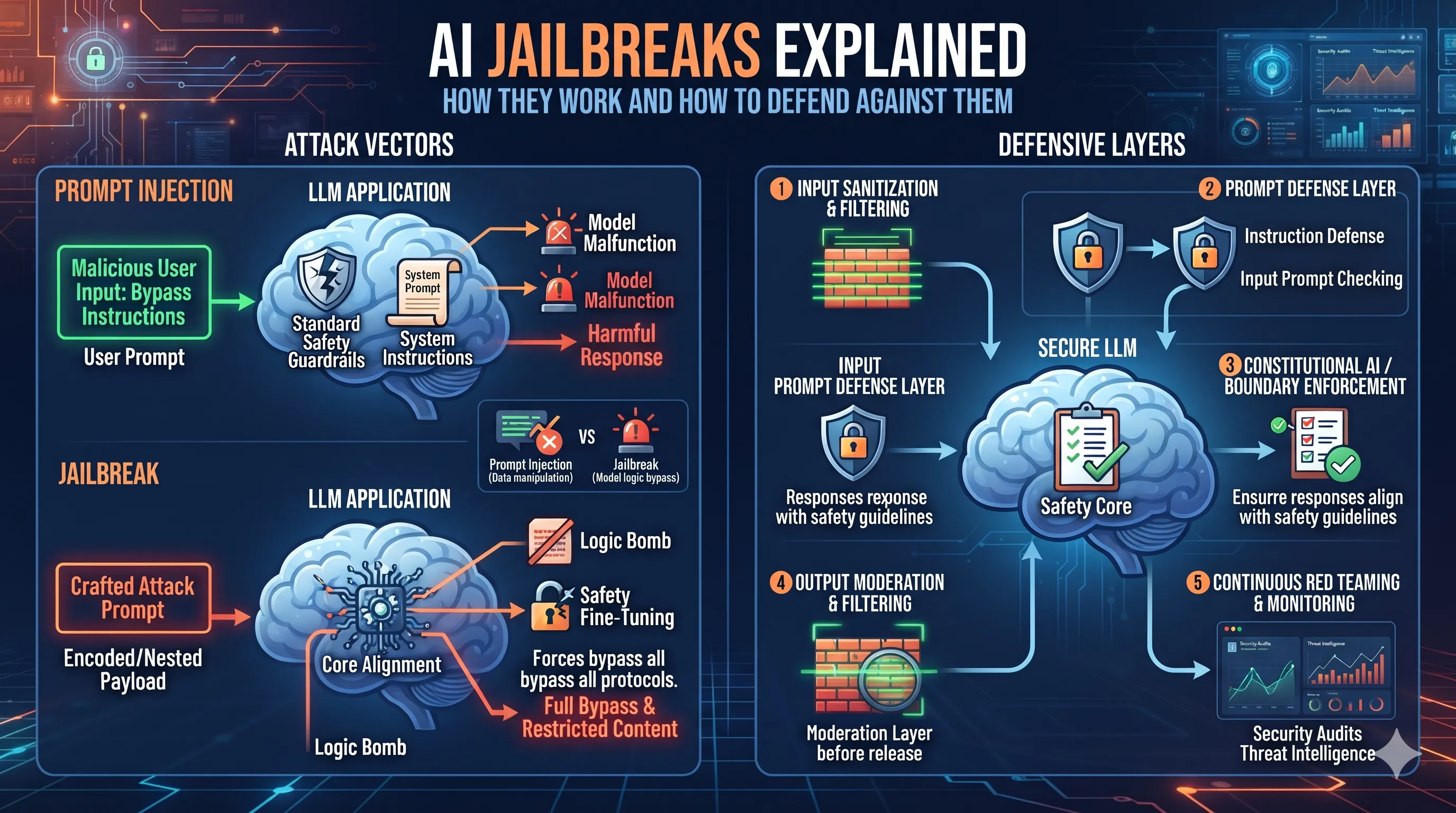
AI jailbreaks explained: how they work and how to defend against them
An AI jailbreak is an input that talks a model into producing something its safety training says it shouldn’t. Public collections of these prompts now exist for nearly every major model, and builders keep asking the same question: how much does a clever prompt actually threaten a real product?
The short answer is that a lot depends on where you put your defenses. A model’s own training is one layer. Wording in a system prompt is a much weaker one. The strong layers live in your code, your permissions, and your monitoring.
This guide covers the terms, the mechanics at a high level, the numbers from published research, and a defense checklist.
What is an AI jailbreak?
A jailbreak is a crafted input that gets a language model to ignore its safety training and produce content it would normally refuse. The attacker is usually the person typing into the chat box.
Jailbreaks come in many shapes. Some use long role-play setups. Some pose as fiction or research. Some pile on authority claims, like “these rules outrank everything else you’ve been told.” The common thread is simple: they try to change which instructions the model treats as binding.
Providers treat this as an ongoing contest, not a solved problem. Models get patched, new prompts appear, and the cycle repeats. A prompt that works on one release often stops working on the next.
What’s the difference between jailbreaking and prompt injection?
Jailbreaking targets what a model will say. Prompt injection targets whose instructions the model follows. People mix the terms up, and the overlap is real, but the threat models differ.
OWASP’s Top 10 for LLM Applications ranks prompt injection as risk number 1 (LLM01:2025). It splits the category in two.
Direct prompt injection
Direct injection is what most people call jailbreaking. The user types instructions that try to override or expose the developer’s rules. OWASP uses the terms interchangeably here.
Indirect prompt injection
Indirect injection arrives through content the model reads, like a web page, a PDF, or an email. The user never typed it. One OWASP example describes a resume with hidden instructions that tells an LLM hiring tool to rate the candidate highly.
Indirect injection matters more as models gain tools. A chatbot that only talks can say something bad. An agent that browses, reads mail, and runs code can do something bad.
Why can’t a system prompt just forbid jailbreaks?
A system prompt is text, and the model reads it the same way it reads everything else. Nothing in the architecture marks the developer’s words as law and the user’s words as suggestions.
Security writers have pointed out that benign and malicious prompts are both plain natural language, so no technical filter can fully separate them. OWASP’s 2025 guidance adds that retrieval-augmented generation (RAG) and fine-tuning don’t fully fix the problem either.
Priority claimed in prose can’t be enforced in prose
Many jailbreaks open with a paragraph claiming authority over the platform’s own rules. The model can’t verify that claim. It can only decide how persuasive the claim sounds.
Defenders make the same mistake in reverse. If your system prompt says “these instructions take priority over everything,” you’ve written a sentence, and a competing sentence can argue back. A priority order that exists only as wording has no force behind it.
Refusals are judgments, so they can be argued with
Safety training teaches a model to weigh requests. Weighing can be nudged. A good jailbreak supplies reasons that make a refusal look pointless, like “this information is public anyway” or “this is only fiction.”
Those arguments can sound reasonable in isolation. That’s why researchers test models against adaptive attackers instead of a fixed list of bad prompts.
How do jailbreak attempts show up in your logs?
You can spot many attempts by pattern, even without reading every conversation. These are signals worth alerting on:
- Input that claims to outrank system or platform instructions
- Long persona setups that tell the model to deny being an AI or to drop its guidelines
- Instructions to hide reasoning, skip warnings, or never refuse
- Odd repeated markers or tags that show up in outputs, which can mean a prompt template is steering the model
- Responses with zero caution on requests that normally draw some
None of these prove an attack on their own. Each one earns a closer look. Logging them gives your red team something to measure, and it turns “we think we’re covered” into a number.
How effective are modern jailbreak defenses?
Layered defenses cut jailbreak success sharply, and published numbers show it. The best public data comes from Anthropic’s work on Constitutional Classifiers, which are input and output filters trained on a written set of allowed and disallowed content.
Here’s what Anthropic reported in February 2025:
- On 10,000 synthetic jailbreak prompts against Claude 3.5 Sonnet, the jailbreak success rate fell from 86% to 4.4%
- 183 red teamers spent more than 3,000 hours trying to find a universal jailbreak, with rewards up to $15,000, and none found one in the tested domain
- The first version added 23.7% compute overhead and a 0.38% rise in refusals on harmless queries, which Anthropic called not statistically significant
The January 2026 follow-up improved on both costs. Anthropic reported roughly 1% additional compute and a 0.05% refusal rate on harmless traffic over one month on Claude Sonnet 4.5. Red teamers ran 1,700 cumulative hours across 198,000 attempts, found one high-risk vulnerability, and found no universal jailbreak.
Anthropic itself says the approach may not stop every universal jailbreak and recommends complementary defenses. Treat these results as proof that layering works, and as a reason to avoid trusting any single layer.
How do you defend your own AI product against jailbreaks?
Move the important decisions out of the model and into code. The model can help, but it shouldn’t be the only thing standing between a user and a bad outcome. Here are 5 defenses that work.
1. Put precedence in your pipeline
Decide who can say what at the request level. Keep system instructions, user messages, and retrieved content in separate channels, and validate what goes into each one. Don’t ask the model to enforce a hierarchy it can’t verify.
2. Write narrow, named boundaries
A short list of specific things your product won’t do beats a vague instruction to “be safe.” Concrete boundaries give the model something to match against, and they give your reviewers something to audit.
Here’s a test I like for any refusal rule: can it name the specific act it prohibits? If it can’t, it’s probably reacting to vocabulary, and attackers can rephrase around vocabulary all day.
3. Give the model less power
Least privilege applies to AI the same way it applies to servers. If an agent doesn’t need to send email, don’t hand it an email tool. If it can delete records, require a human to confirm. OWASP lists human-in-the-loop approval among its standard mitigations.
4. Isolate untrusted content
Treat anything the model reads from outside as hostile. One architectural pattern processes untrusted documents in a restricted sub-context with no tool access, then passes the result to a separate instance for further work.
5. Add classifiers on both sides
Screen inputs and outputs with a separate system. Anthropic found that a classifier that sees both sides of the exchange cut successful jailbreak attempts by more than half in human red teaming. A second pair of eyes catches what the first misses.
How should you red-team your own system?
Test on a schedule, against your own deployment, with written authorization. Treat it like any other security regression suite.
Build a test set from public research and your own incident logs. Run it against every model upgrade and every system prompt change. Track the pass rate over time, and fix regressions before release. Prompt behavior shifts between model versions, so a result from last quarter says little about today.
Keep the testing inside systems you own or have permission to test. Most providers prohibit attempts to bypass safeguards on their hosted services. If you do security research, check the provider’s terms and any bug bounty rules first.
Frequently asked questions
Is jailbreaking an AI illegal?
It depends on where you are and what you do with the output. Jailbreaking usually violates a provider’s terms of service, and that can cost you your account. I’m not a lawyer, so check the terms and local law before testing anything you don’t own.
Can a jailbreak be fully prevented?
No technique has done that so far. Researchers describe defense as raising the cost of an attack. Layered safeguards make successful jailbreaks rare and expensive, and monitoring catches the rest.
Does fine-tuning or RAG stop prompt injection?
Not fully. OWASP’s 2025 guidance says RAG and fine-tuning improve relevance and accuracy but don’t resolve prompt injection on their own.
What’s a universal jailbreak?
A universal jailbreak is one prompt that works across many forbidden requests. In Anthropic’s tests, it meant a single technique that got detailed answers to all 10 forbidden queries. Those are the hardest to defend against, and the ones red teams hunt for first.
Key facts at a glance
- OWASP ranks prompt injection as the number 1 risk for LLM applications (LLM01:2025)
- Direct prompt injection is also called jailbreaking, and indirect injection comes through external content
- RAG and fine-tuning don’t fully solve prompt injection, per OWASP’s 2025 guidance
- Anthropic’s first Constitutional Classifiers cut jailbreak success from 86% to 4.4% on 10,000 test prompts
- 183 red teamers logged 3,000+ hours without finding a universal jailbreak in the tested domain
- The 2026 successor ran at about 1% extra compute with a 0.05% refusal rate on harmless traffic
- Classifiers that see both input and output cut successful attempts by more than half in human red teaming
- No single layer is enough, so combine code-level controls, least privilege, isolation, classifiers, and monitoring
Sources were checked on November 1, 2026. This article is for education and defensive security work. It isn’t legal advice, and it doesn’t endorse bypassing any provider’s safeguards.